
Green to Clean Charlotte, NC
Green, black or swampy pool water brought back to clear with chlorine, brushing and filtration across Charlotte, Matthews, Weddington, Waxhaw, Fort Mill and Indian Land.

Green to Clean Pool Recovery for Charlotte Pools
Most green pools do not need to be drained. They need chlorine, a brush and a filter cleaned more than once.
Algae needs three things: light, warmth and food. Charlotte supplies all three from May through September. Afternoon thunderstorms wash lawn fertilizer and red clay into the pool, and phosphates from fertilizer are algae food. A week of vacation with the pump timer off, a dead pump nobody noticed, or a chlorinator that ran empty is all it takes. Pools under willow oaks in Myers Park and Dilworth go green over winter under a leaf blanket. New owners in Ballantyne and Matthews inherit a swamp with the house keys.
Damon’s Pool Care clears green and black water pools with chemistry, brushing and filtration, all at once. We test first, because stabilizer that is too high or metals in well water change the plan. Then chlorine goes in at a level that kills algae fast. The pump runs around the clock, every surface gets brushed, and the filter gets cleaned as often as it clogs. On a swamp that can be several times. Flocculant or clarifier comes in where dead algae will not settle. We drain only when there is no other way: mud, dead algae too dense to filter, or stabilizer so high that chlorine cannot work.
Light green water usually clears in a few days. A black swamp takes a week or more. Both start with a call to (980) 998-3777 or a quote request with a photo. Green to clean is one of our specialty pool services. Most owners move onto weekly service afterward so it does not happen twice.
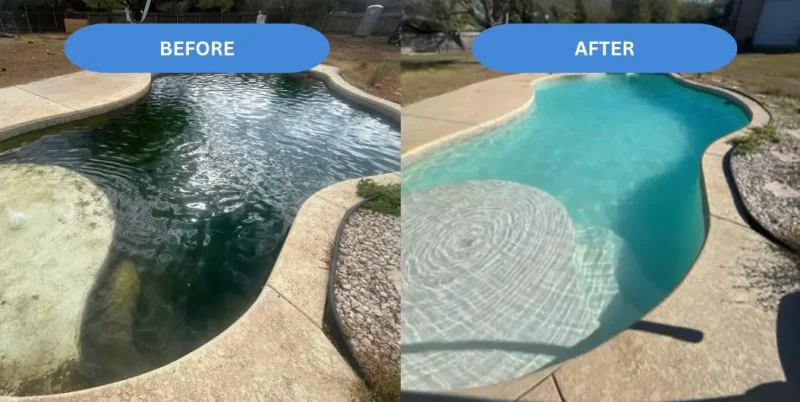




Why Pools Go Green in Charlotte and Why Green to Clean Is a Process
Light, heat and fertilizer runoff, plus the one week nobody was watching.
Chlorine at 2 to 4 ppm keeps algae from getting started. The moment chlorine drops to zero in warm water, algae spores already in the pool bloom. In a Charlotte July that can happen in a couple of days. Here is what pushes a pool over the edge most often.
Summer heat and storm runoff
Water in the mid 80s is a greenhouse. Every afternoon storm from June through September washes fertilizer, grass clippings and Piedmont red clay into the pool. Fertilizer brings phosphates and nitrates. Clay brings fine silt that clouds the water and shades the algae from the chlorine. Add a chlorinator that ran out midweek and you have the classic Charlotte green pool. It happens to well-kept pools too, not just neglected ones.
Leaf load and the winter swamp
Willow oaks shed small, narrow leaves from October through December. They sink, rot and feed algae through a mild Charlotte winter. A pool under a leaf blanket with the pump on a short winter schedule goes from clear to black by March. The leaves also leave tannin stains, and the dead algae leaves a grey ghost on plaster. That is where our acid wash and chlorine wash service picks up if needed.
Equipment failures nobody saw
A pump that lost prime after a filter cleaning. The timer clock that drifted after a storm. A salt cell that scaled over and stopped making chlorine. Or a filter so loaded it barely moved water. Each one takes chlorine to zero, and the pool follows within days. Part of every green to clean job is finding out why it went green. Clearing the water without fixing the cause means doing it again in August.
Stabilizer that climbed too high
Trichlor tablets add stabilizer, also called cyanuric acid, with every pound. After a few seasons it can sit far above the 30 to 50 ppm range. High stabilizer slows chlorine down so much that a normal shock does nothing. Owners describe it as chlorine lock. The chlorine is there, it is just too tied up to kill algae. This is one of the most common reasons a pool will not clear after shock after shock. The only fix is a partial drain to bring stabilizer down.
None of these are about bad owners. They are about a warm climate, a lot of trees and equipment that needs watching. Weekly service exists for exactly that reason.
What Our Green to Clean Service Includes
Every recovery follows the same steps. How long each one takes depends on how dark the water is and what the test kit says on day one.
Test and diagnose
We test free chlorine, combined chlorine, pH, alkalinity, calcium and stabilizer. On well water pools in Union County we test for metals too. Stabilizer decides whether we chlorinate or partially drain first. Metals decide whether we add a sequestrant before chlorine, since shocking iron-laden water turns it brown. We also check the pump, filter and chlorinator so we know why the pool went green.
Debris out, water moving
Leaves, sticks and anything the net will catch come out first. Dead organic matter eats chlorine. You do not want to pay for chlorine that goes into killing leaves. The pump goes on and stays on 24 hours a day until the pool is clear. Skimmer and pump baskets get emptied every visit.
Chlorine at a level that kills
We bring free chlorine up to a shock level sized to the stabilizer reading and hold it there. That means testing and re-dosing until chlorine stays up overnight on its own. Holding it is the part owners miss. A single bag of shock lifts chlorine for a few hours and then algae takes over again. Green algae, the common kind, dies within a day or two at a held shock level. Black algae in grout and rough plaster needs trichlor granules worked in with a brush. Yellow or mustard algae needs its own algicide and a cleaning of everything that touched the water.
Brush everything, every visit
Algae clings to walls, steps, tile grout and the corners where water barely moves. Brushing breaks the film so chlorine reaches it. Every visit during a recovery includes a full brush of walls, floor, steps and the tile line. Dead algae then drops to the floor where the filter and the vacuum can get it. Corners behind ladders and the backs of steps get extra attention. So does the light niche, which stays dark and still and often grows algae first.
Filter, filter, filter
Dead algae is fine and sticky. It packs a cartridge or a DE grid in hours and a sand bed in a day or two. On a swamp recovery we clean or backwash the filter every time pressure climbs 8 to 10 psi over its clean number. On day one that can mean more than once a day. A pool only clears as fast as its filter can pull dead algae out. Where dead algae stays suspended, a flocculant drops it to the floor and we vacuum it to waste so it never touches the filter. See filter cleaning for what a proper cleaning involves.
Drain and clean when there is no other way
Draining is the last option, not the first. We drain when stabilizer is too high for chlorine to work, when mud or dead algae is too dense to filter in any reasonable time, or when the floor is a layer of decayed leaves. Drain timing matters in Charlotte. A wet week or a high water table can lift a shell. Once refilled, soft Charlotte water needs calcium and alkalinity added right away so the plaster does not etch.
After the water is clear, we vacuum the floor, clean the filter one more time, check the pump for strain and set chlorine and stabilizer back into range. A sand filter that swallowed a green recovery is often due for a sand change, since the top of the bed cements with dead algae and clay. Pools with a salt system get the cell inspected, because a scaled cell is a common reason the pool went green in the first place.
How Long Does Green to Clean Take?
Light green water with a visible floor clears in two to four days with chlorine held and the pump running. Dark green with no visible floor takes about a week. Black water with a leaf layer on the bottom runs a week to two weeks, and sometimes a drain is faster. Two variables stretch the timeline: stabilizer and the filter. High stabilizer means a partial drain before anything works. An undersized or worn filter means more cleanings and slower progress. We tell you which category you are in on the first visit and update you as it goes. Weather matters a little too. A string of 95 degree days feeds the algae while we fight it, and a cool cloudy week is on our side.
Signs Your Pool Needs Green to Clean, and What to Expect
The water is any shade of green, or you cannot see the bottom step. Walls feel slimy. There is a tint even after a bag of shock. Black spots on the grout or steps do not brush off. Yellow dust gathers on shady walls and comes back after brushing. Any of those means more than a weekly visit can handle in one stop.
Expect repeat visits during recovery, chlorine levels well above swimming range, and the pump running day and night. Nobody swims until the water is clear and chlorine and pH are back in range. The CDC’s healthy swimming guidance is plain about that. Cloudy water hides swimmers and carries germs chlorine has not reached. Expect, too, a conversation about why it went green and what to change so it does not again.
Why Charlotte Homeowners Choose Damon's for Green to Clean
A green pool invites two bad sales pitches: drain it when it does not need draining, or dump shock in it and hope. We do neither. We test, we size the chlorine to the stabilizer reading, we hold it, we brush and we clean the filter as many times as it takes. The written quote spells out the recovery plan, including filter cleanings. It also names the one thing that would change it: a drain, if the chemistry forces one. Pricing depends on how dark the water is, the pool’s size, the filter type and whether a drain is needed, so we quote after seeing it or a clear photo.
Damon has serviced Charlotte pools for more than ten years. He has brought back swamps from Myers Park and Eastover to Ballantyne, Providence Plantation, Matthews, Weddington, Waxhaw, Fort Mill and Indian Land. His Google reviews keep saying the same things: honest about what you need, fair on price, and the water stays clear. Call (980) 998-3777 or request a quote and send a photo of the water. You will hear whether it is a few days or a week, and whether a drain is on the table. Most owners move onto weekly pool service afterward, from $100 a month for Chemical Only, so the pool never gets the chance again.
Our Service Areas
- Charlotte, NC
- Ballantyne
- Matthews
- Stallings
- Weddington
- Wesley Chapel
- Waxhaw
- Marvin
- Fort Mill, SC
- Indian Land, SC
Green to Clean Questions From Charlotte Homeowners
What owners ask when the pool has turned. Send a photo with your quote request and we can usually tell you the timeline from it.
It depends on how dark the water is, the pool's size, the filter type and whether stabilizer or mud forces a drain. A light green pool with a visible floor is a few visits. A black swamp is a week or more of chlorine, brushing and repeated filter cleanings. Damon's Pool Care quotes in writing before starting, and tells you up front if a drain might change the number.
Light green, two to four days. Dark green with no visible floor, about a week. Black water with leaves on the bottom, one to two weeks, or less if a drain makes sense. Chlorine has to be held at shock level the whole time and the filter cleaned every time it clogs. Stabilizer above range stretches every one of those because chlorine works slower.
Water testing including stabilizer and metals, debris removal, and chlorine dosed to shock level and held with repeat visits. Brushing of every surface each visit, and filter cleaning or backwashing as often as pressure demands. Flocculant and vacuum to waste where dead algae will not settle. A partial or full drain only when chemistry requires it. A final vacuum and filter clean, plus a check of the pump, filter and chlorinator to find out why it went green.
You can, and for a light green pool it often works if you hold the chlorine. Test stabilizer first. If it is far above 50 ppm, shock will not hold and you are wasting money. Brush everything, run the pump 24 hours a day and clean the filter every time pressure climbs. If it is still green after a few days of real effort, the cause is usually stabilizer, a filter that cannot keep up or a pump problem.
Usually not. Most green pools clear with held chlorine, brushing and filtration. Draining is for three cases: stabilizer so high that chlorine is useless, mud or dead algae too dense to filter in reasonable time, or a floor covered in rotted leaves. Draining in Charlotte needs dry weather and a low water table. A refill with soft tap water means calcium and alkalinity must be added immediately. We drain when it is faster or cheaper, not as a reflex.
Almost always one of three things. Stabilizer is too high and chlorine cannot work, so test it. Chlorine is not being held: a dose that reads high at night is gone by morning while algae is still alive. Or the filter is clogging within hours and nobody is cleaning it, so dead algae stays in the water. Check stabilizer, hold chlorine with testing twice a day, and clean the filter every time pressure climbs.
Because algae and organic matter are eating it as fast as you add it. That is normal early in a recovery. It means you need more chlorine, dosed more often, not a different chemical. Keep adding and testing until chlorine survives overnight. If stabilizer is very high the reading is also misleading, because the chlorine is tied up rather than gone. Test stabilizer and consider a partial drain if it is well over range.
Shocking is usually cheaper on chemicals alone but can take two weeks of daily work and several filter cleanings. Draining costs water, start-up chemicals for soft Charlotte fill water and a day or two of downtime. It can be done in a few days when weather allows. Stabilizer tips the balance. If it is far over range, draining some water is unavoidable anyway. We price both and recommend the one that gets you swimming sooner.
Start with a photo and a water test, including stabilizer and metals if the home is on a well. Then get the equipment checked, because a swamp usually means the pump, filter or chlorinator was not working. Do not drain it on your own; a drained shell in a wet week can lift. Once we know the chemistry and the equipment, we quote a recovery with a realistic timeline. You get a clean pool and working equipment at the same time.
No. Chlorine is held well above swimming range during a recovery, and cloudy water hides the floor and anyone on it. Wait until the water is clear enough to see the main drain, free chlorine is back to 2 to 4 ppm and pH is 7.4 to 7.6. We test and tell you when. Showering before swimming and keeping leaves and lawn runoff out help it stay that way.