
Pool Filter Cleaning Charlotte, NC
Cartridge, DE and sand filters pulled apart, cleaned properly, inspected and put back on pressure. Charlotte, Matthews, Waxhaw and Fort Mill.

Pool Filter Cleaning Built for Charlotte Pollen, Clay and Storms
A hose rinse in the driveway is not a filter cleaning. Here is what one actually involves.
Your filter is the only thing between a Charlotte pool and the pollen, red clay and leaf litter that land in it all year. Pine pollen in April packs a cartridge in a couple of weeks. Summer thunderstorms wash Piedmont clay and lawn fertilizer into the water as a silt. Cartridges and DE grids trap it until pressure climbs and flow drops. Willow oak leaves in October finish the job. Most cloudy-water calls we take in Charlotte end at the filter, not the chemicals.
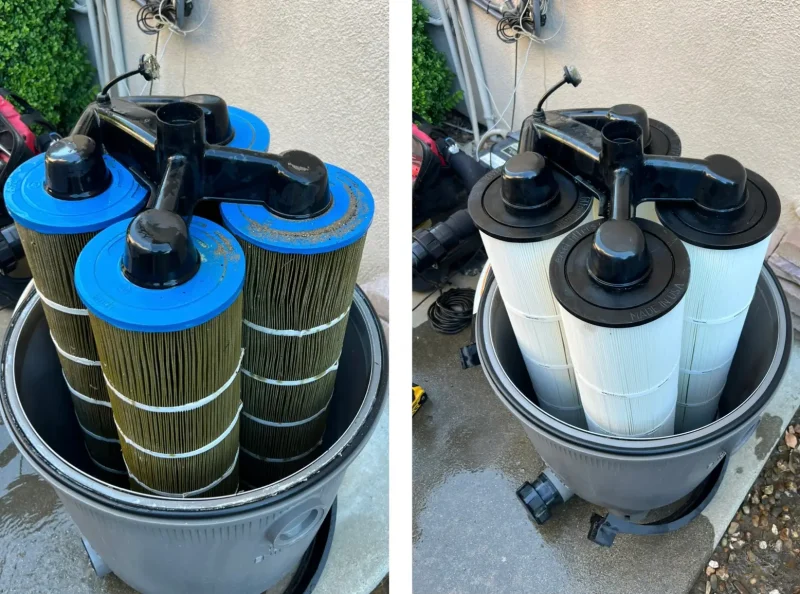
Damon’s Pool Care cleans every residential filter type on Charlotte equipment pads: cartridge filters, DE (diatomaceous earth) grids and sand filters. A cleaning means the filter comes apart. Cartridges and grids are pressure-washed, then soaked in a degreaser and, where calcium has set in, an acid bath. The order matters so the oils do not get locked into the fabric. Manifolds, O-rings, laterals, the clamp band, the air relief and the pressure gauge get inspected while the tank is open. DE filters are recharged with the right weight of powder. Then the system goes back together, gets primed and pressure-tested, and you get a report with the clean starting pressure written on it.
Weekly service customers get two of these cleanings a year as part of the plan. Everyone else can book one as a standalone job, usually in spring and fall. If the gauge is already 8 to 10 psi over its clean number, the filter is due now.




Why Pool Filter Cleaning Is Essential in Charlotte
What Charlotte puts through a pool filter in a year
A pool filter does one job: hold back particles the skimmer basket cannot. Cartridges catch particles down to roughly 10 to 25 microns. DE grids go down to 2 to 6 microns, and sand is the coarsest of the three. Everything they catch stays in the filter until someone takes it out. In Charlotte, that is a lot of material.
Spring pollen
Oak and maple pollen start in March, and the loblolly pine pollen that paints the city yellow peaks in mid to late April. Pollen is small enough to pass a skimmer sock. Pollen is also sticky enough to pack the pleats of a cartridge or coat a DE cake within days. It is the number one reason Charlotte filters need a spring cleaning. It is also why a cartridge that was fine in February is 10 psi high by May.
Red clay and storm silt
Charlotte sits on Piedmont red clay. Every summer thunderstorm washes fine clay and yard dirt off decks and lawns and into the pool. It goes straight to the filter as a silt that packs deeper into the media than leaves ever do. After a wet July, a cartridge can look clean from the outside and still be loaded in the pleats. That is why we do not judge a filter by how it looks on the pad. We judge it by the gauge and by what comes out of the pleats under a pressure wand.
Leaves and organic load
The willow oaks that line Myers Park, Dilworth and Eastover drop narrow leaves from October into December. They slip past skimmer baskets and break down in the water. Leaves, grass clippings, bird droppings and swimmer oils all become organic load. It uses up chlorine and coats filter media with a greasy film that water cannot pass through. A degreaser soak is what removes it; a hose does not.
Soft water, but still scale
Charlotte Water comes out of the tap very soft, which is why we add calcium to most pools. That calcium, plus a pH that drifts up over a season, can still deposit scale inside a cartridge or on DE grids. Pools with a heater see it most. Scaled media feels stiff and chalky and will not come clean with pressure alone. That is where the acid bath comes in, always after the degreaser.
Left too long, a packed filter shows up as cloudy water with the chemistry right, weak returns, a pump that runs hot and loud, and higher power bills. Eventually it means a cracked clamp band or torn grids, which turns a cleaning into a repair.
Types of Pool Filters We Clean
We service all three filter types used on residential pools in Charlotte as part of our pool cleaning work. Each needs a different cleaning, and the mistakes owners make are different for each.
Cartridge filters
The most common filter on Charlotte pools built in the last 20 years. Cartridges are cleaned, not backwashed: the tank is opened, the cartridges come out, every pleat is washed from the top down, then the cartridges soak. The mistakes we fix most are two. Acid used before a degreaser sets oil permanently into the fabric. Cartridges reinstalled on a worn O-ring let water bypass the filter, which leaves pressure high after a cleaning.
DE filters
DE grids give the finest filtration of the three, and they need the most care. We open the tank, remove the grid assembly and wash every grid. Each one and the manifold get checked for tears or cracks. Then we reassemble and recharge with the correct weight of DE powder for the filter’s square footage. Too little powder lets oils and dirt clog the fabric and damages grids; too much bridges the grids together. DE powder is handled carefully and kept away from the pump, because it is airborne easily and harmful to breathe.
Sand filters
Sand filters are backwashed, not disassembled, and the rule is pressure, not the calendar. When the gauge reads 8 to 10 psi above the clean starting pressure, backwash until the sight glass runs clear, then rinse. Backwashing more often than that makes the water worse, because a sand bed filters better once it has caught some dirt. During a filter cleaning on a sand system we open the tank, check the sand for clumping and channeling, and inspect the laterals and standpipe. We also service the multiport valve spider gasket, which is the usual source of water lost to the waste line.
Whatever the tank, you get a price before anything is replaced if we find a cracked grid, a torn pleat band, a dead gauge or a brittle clamp band. Filter repairs and sand changes are handled by the same crew.
What Our Pool Filter Cleaning Service Includes
Every filter cleaning in Charlotte follows the same five steps. The result is the same whether it is the spring rush or a slow week in January.
1. Pump off, pressure released, tank opened
We shut the system down, open the air relief, drain the tank and remove the clamp band or lid. The clean starting pressure from the last visit is checked against today’s reading before we touch anything. That way you can see on paper how loaded the filter was.
2. Full disassembly
Cartridges, DE grid assemblies, manifolds and internal parts come out of the tank. On sand filters we open the top and inspect the bed and laterals. Nothing gets cleaned inside the tank.
3. Pressure wash, then soak
Each cartridge or grid is washed with a pressure wand, pleat by pleat, from the top down. That way what comes off runs out rather than deeper in. Then the media soaks in a filter degreaser to lift oils and pollen residue. Only afterward does it soak in a diluted acid solution, and only if there is calcium scale. That order matters: acid first locks oils into the fabric for good.
4. Inspection and DE recharge
While the tank is empty we inspect every grid and cartridge for tears and crushed pleats, and the manifold for cracks. We also check the tank O-ring and clamp band, the air relief screen, the pressure gauge and the backwash or multiport valve. Worn parts are quoted before replacement. DE filters are recharged with the correct amount of powder added through the skimmer with the pump running.
5. Startup and pressure test
The system is reassembled with the O-ring lubricated, primed, bled of air and run up to pressure. We watch for leaks at the clamp band and record the new clean starting pressure. You get a report with before and after pressure, what we found, and what we recommend.
How Often Should You Clean a Pool Filter in Charlotte?
Pool filter maintenance in Charlotte runs on the gauge, not the calendar. Clean or backwash when pressure rises 8 to 10 psi over the clean starting pressure. On most residential filters that is about a quarter above the clean reading. In practice, for Charlotte pools that works out to a full cleaning every three to six months. Pools under pines and oaks, pools without a cover, and pools that saw a green episode land at the short end. Weekly service customers get two full cleanings a year built into the plan, timed after pollen season and after leaf fall. Extra rinses happen in between if the gauge calls for it.
Signs Your Pool Filter Needs Cleaning
Pressure 8 to 10 psi above the clean number is the first and most reliable sign. Water that stays hazy or dull with chlorine and pH in range is the second, and that one is a safety issue as much as a cosmetic one (the CDC’s healthy swimming guidance expects you to see the bottom clearly). After that come weak flow at the returns, the automatic cleaner stalling or crawling, and debris blowing back into the pool. The pump gets louder or hotter than usual. Chemicals will not hold because the water is not turning over. Air bubbles or surging show up at the pump as it strains against a packed filter. DE powder or sand in the pool is a different problem. That is a torn grid or a cracked lateral, and it needs a repair, not a cleaning.
Why Charlotte Homeowners Choose Damon's for Pool Filter Cleaning
Plenty of pool companies in Charlotte will hose a cartridge in the driveway and call it a filter cleaning. The cartridge looks clean and the pressure is back up within a month, because the oils and the clay are still in the pleats. We take the filter apart, soak the media in the right order and inspect everything while the tank is open. Then we write the pressure numbers down, so the next cleaning is based on data rather than a guess.
Damon has serviced Charlotte pools for more than ten years. His Google reviews keep saying the same things: honest about what you need, fair on price, and the water stays clear. If a cartridge is at the end of its life we tell you, with a price. We do not clean it one more time and send an invoice. Filter cleaning is included twice a year on weekly service. It is also available as a one-off job across Charlotte, Matthews, Weddington, Waxhaw, Marvin, Fort Mill and Indian Land. Call (980) 998-3777 or request a free quote and tell us what the gauge says.
Our Service Areas
- Charlotte, NC
- Ballantyne
- Matthews
- Stallings
- Weddington
- Wesley Chapel
- Waxhaw
- Marvin
- Fort Mill, SC
- Indian Land, SC
Pool Filter Cleaning Questions From Charlotte Homeowners
Straight answers to what Charlotte homeowners ask us about pool filters. Still stuck? Call and read us the gauge.
When the pressure gauge reads 8 to 10 psi above the clean starting pressure. On most home filters that is about a quarter higher than the clean reading. For Charlotte pools that usually means a full cleaning every three to six months, sooner for pools under pines and oaks or without a cover. Sand filters are backwashed on the same pressure rule, not on a weekly schedule.
Pump off, air relief open, tank drained and opened. Wash each pleat from the top down with a pressure wand so debris runs out, not in. Soak in a filter degreaser to lift oils and pollen, then, only if there is calcium scale, in a diluted acid solution. Rinse, check the pleat bands and end caps, lubricate the tank O-ring, reassemble, prime and record the clean pressure. Acid before degreaser is the mistake that ruins cartridges.
It depends on the filter type and size. A single cartridge is the smallest job; a four-cartridge or DE grid system takes longer and uses more cleaning solution. Damon's Pool Care gives a price before the tank is opened, and any worn part found inside is quoted separately before it is replaced. Weekly service customers get two cleanings a year included.
Nine times out of ten the media is loaded with pollen, clay silt or oils and needs a proper cleaning. If pressure is high right after a cleaning, one of four things is going on. The cartridge was not cleaned all the way through, the tank O-ring is letting water bypass, a valve is partly closed, or the gauge itself has failed. A dead gauge is a cheap part and a common one, so we check it before anything else.
Three to five years on most Charlotte pools with cleanings on the pressure rule. Pools under heavy trees, or that have been through a green recovery, get less. Cartridges usually fail by falling apart rather than clogging. Look for pleats stuck together in groups, broken bands, crushed end caps, or pressure that stays high after a thorough clean. If the pleats are intact and separated, it just needs cleaning.
Usually nothing dramatic. Either fine pollen and clay are still deep in the pleats, because a garden hose cannot reach them, or the cartridge went back in on a worn or dry O-ring. In the second case water is bypassing the media. Reseat the cartridge, lubricate the O-ring, and compare pressure at the same pump speed as before. If it is still high, the cartridge needs a degreaser soak or it is at the end of its life.
No, it is damaged. DE powder in the pool means a torn grid, a cracked manifold, or a missing air relief screen. More cleaning will not fix it. We open the tank, pull the grid assembly and find the breach. The filter is repaired or the grid replaced, then recharged with fresh DE. Sand in the pool from a sand filter is the same story: a cracked lateral or standpipe, which is a repair.
Sand and DE filters are backwashed, and that handles most of the routine loading. But backwashing does not remove oils, scale or pollen residue. That is why DE grids and sand beds still need the tank opened once or twice a year. Cartridge filters cannot be backwashed at all. And backwashing a sand filter too often makes water clarity worse, because sand filters better once it has caught some dirt.
Only when there is calcium scale, only diluted, and only after the degreaser soak. Acid used first sets the oils and grease into the fabric permanently. That is the most common way a cartridge gets ruined in a driveway cleaning. Most Charlotte cartridges only need the degreaser; the acid step is for pools with a heater or a lot of calcium additions.
Yes. Both of our weekly plans, Full Service and Chemical Only, include two full filter cleanings a year. They usually fall after pollen season in spring and after leaf fall. The technician also checks the gauge every week and rinses or backwashes between cleanings when the pressure calls for it. Owners who are not on weekly service can book a cleaning on its own.