
Pool Light Installation Charlotte, NC
LED pool light installation, replacement and repair for in-ground pools and spas in Charlotte, Matthews, Weddington, Waxhaw, Fort Mill and Indian Land, without draining the pool.

Pool Light Installation and Replacement in Charlotte
A new LED light, a flooded fixture fixed, or a GFCI that finally stays on. The pool stays full.
A lot of Charlotte pools still run the light they were built with. In Myers Park, SouthPark and Providence Plantation that often means a 300 to 500 watt incandescent bulb in a wet niche. The wiring dates to the 1980s or 1990s. Lens gaskets go brittle after decades of summer heat and January freezes. Water gets into the fixture, the bulb pops, and the breaker trips or the light simply goes dark. Many of those older circuits never had GFCI protection at all. Most owners assume fixing any of this means draining the pool. It does not.
Damon’s Pool Care installs and replaces pool and spa lights across Charlotte without lowering the water. The cord in the niche is long enough to bring the fixture up onto the deck. We test the circuit and GFCI, pull the old fixture, and fit the new LED light with a fresh gasket and lens. The new cord goes through the existing conduit to the junction box. The fixture is bonded and everything is tested on the GFCI before we leave. We install Pentair IntelliBrite, Hayward ColorLogic and Jandy LED and color-changing lights. Retrofits, nicheless wall lights, spa lights and app control are all on the list. When a job needs a licensed electrician, such as a new circuit, that goes in the quote.
If your light is out, tripping the GFCI or showing water behind the lens, call (980) 998-3777 or request a quote. We work in Charlotte, Matthews, Stallings, Weddington, Wesley Chapel, Waxhaw, Marvin, Fort Mill and Indian Land.
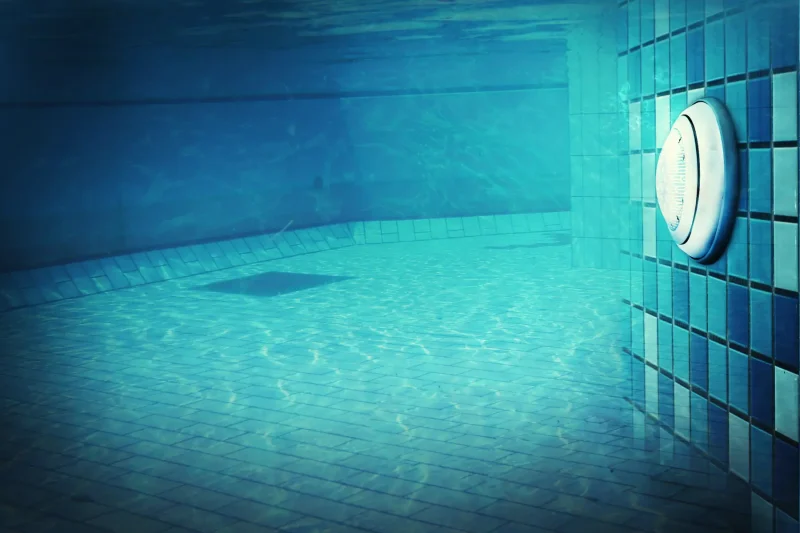




Why Pool Light Installation Matters in Charlotte
Old fixtures, old wiring, and a swim season that runs well after dark.
A pool light is the one piece of equipment that sits in the water with people. That makes it the one place where a cheap shortcut matters most. Charlotte has a large stock of pools built from the late 1970s through the 1990s. Many still carry their original lighting. Here is what we run into on those pools and why it matters.
Pools over 30 years old and GFCI
Underwater lighting circuits must have GFCI protection under NEC Article 680. Pools built more than 30 years ago may not have it. We find plenty of them in Eastover, Dilworth and older parts of Matthews, running a wet niche light on a plain breaker. A plain breaker trips on a big short. It does nothing about the small current leaks that matter to a swimmer. Any light we install goes on GFCI protection, and we test it before the fixture goes back in.
Heat, freezes and failed gaskets
A pool light fixture is sealed by a gasket between the lens and the housing. Charlotte gives that gasket a hard life. The deck bakes in upper 80s to 90s heat from June through September. Then two or three hard freezes in January shrink and crack rubber that is already brittle. Once the seal fails, water sits in the fixture. An incandescent bulb shatters or the socket corrodes. An LED unit shorts internally and trips the GFCI. A flooded fixture is the most common pool light repair we do.
Soft water, bonding and corrosion
Charlotte Water is soft, around 25 ppm calcium hardness. Soft, low-alkalinity water is corrosive to metal. A light niche, its face ring and the screws are metal in the water all year. If the niche is not bonded properly to the rest of the pool’s metal, galvanic corrosion starts. It eats the face ring and screws, and it leaves rust streaks on the plaster below the light. Bonding is not optional on a light install, and a corroded bonding lug is something we check every time.
Evenings are swim time here
From June into September the Charlotte heat makes evening the best time to be in the pool. That is also when lighting earns its keep. Good light lets you see the bottom, see the steps, and see who is in the water. The CDC healthy swimming guidance covers the water side of safe swimming. Lighting is the equipment side of the same job.
A dark pool is an inconvenience. A pool light on an unprotected circuit, or a flooded fixture that keeps getting reset, is a hazard. Both get fixed the same way: a sound fixture, a good seal, a bonded niche and a GFCI that stays on because nothing is leaking.
Pool Lighting Options We Install
Most of our pool light installation work in Charlotte falls into a few categories. The right one depends on your niche, your transformer or voltage, and what you want the pool to look like at night.
LED retrofits into existing niches
This is the most common job. An old 300 to 500 watt incandescent fixture comes out of its wet niche and an LED fixture goes in its place. LED pool lights draw tens of watts instead of hundreds. The light that used to cost real money to run every evening becomes an afterthought on the bill. Pentair IntelliBrite, Hayward ColorLogic and Jandy all make retrofit fixtures for the common large and small niche sizes. We match the fixture to the niche brand and to the voltage already on the circuit.
Color-changing and automation-synced lights
Color LED fixtures run light shows and fixed colors from the switch or from an app. They pair with Pentair IntelliCenter, Hayward OmniLogic and Jandy iAquaLink panels so the pool, spa and landscape lights change together. If your pad already has automation, we wire the new light into it. If not, our pool automation page covers what adding a panel involves.
Nicheless and wall lights
These are small LED lights that mount through a return-style fitting instead of a full niche. Newer pools and some renovations use them. They are usually low voltage, use several small fixtures instead of one big one, and light a free-form pool more evenly. We install them on new plumbing and as additions where a single old niche leaves half the pool dark.
Spa lights
Attached spas usually have their own smaller niche light. It takes the same heat, plus 104°F water and heavy chemical use, so spa light gaskets fail first. We replace spa lights with matching LED fixtures and sync the color with the pool light.
Landscape and deck lighting tie-ins
Landscape lights belong on the same system. Low-voltage lights along the deck, steps and plantings run off the same transformer and automation as the pool light. We tie them into the pool lighting schedule so one button handles the whole backyard. Line-voltage deck wiring is quoted separately and routed to a licensed electrician where the job requires one.
Repairs: GFCI trips and flooded fixtures
Not every call is a new light. A pool light that trips the GFCI, flickers, or shows water behind the lens is a repair. We pull the fixture to the deck, find the water or the fault, and replace the gasket, lens or the fixture itself. If the cord or the junction box is the problem, we trace it there. Pool light repair is quoted the same way as an install, in writing, before anything is replaced.
Lighting is usually one part of a pad upgrade. A new light often goes in alongside a variable-speed pump installation or a pool heater installation, since the automation that runs one runs all three. We quote them together when that makes sense.
How Pool Light Installation Works, Step by Step
The process is the same whether the pool is in Ballantyne or Fort Mill. The pool is not drained at any point.
First, power. We shut the breaker off, confirm the circuit is dead at the junction box, and test the GFCI. If there is no GFCI, that gets addressed as part of the job. Second, the old fixture. The face ring screw comes out and the fixture is lifted off the niche and floated up to the deck on its cord. There is extra cord coiled in the niche for exactly this reason. Third, the swap. The old cord is pulled back through the conduit from the junction box. Then the new fixture’s cord is fed through the same conduit and landed in the box. Niche and bonding lug are checked for corrosion and cleaned.
Fourth, sealing and seating. A new gasket and lens go on if the fixture is a rebuild, or the new sealed LED unit goes on as a whole. The fixture is seated and the face ring is tightened evenly. Fifth, testing. Power on, GFCI test, light on, colors cycled if it is a color fixture, and a look for bubbles at the lens. You get a walk-through of the switch or app control before we leave.
One rule we do not bend: voltage is matched to what is on the circuit. A 12-volt fixture goes on a 12-volt transformer. A 120-volt fixture goes on a 120-volt circuit. Mixing them is how lights fail early and how GFCIs trip for no clear reason.
Signs Your Pool Light Needs Replacing or Repair
Water visible behind the lens is the clearest sign. It means the gasket has failed and the fixture is flooding. A light that trips the GFCI the moment it is switched on is almost always flooded or has a cord fault. A light that trips after running for a while usually has a cracked seal that opens as the fixture heats. Flickering, dim output, or a color light stuck on one color point to the fixture or its driver. Rust streaks on the plaster under the light point to a corroded face ring or a bonding problem. A bulb that burns out every season on an incandescent fixture is a reason to retrofit, not to buy another bulb.
If your light is on a plain breaker with no GFCI anywhere on the circuit, that is a reason to call even if the light works. The same goes for any fixture that has been reset more than once. A GFCI that trips is telling you something is leaking current into the water.
Why Charlotte Homeowners Choose Damon's for Pool Light Installation
A handyman will swap a pool bulb, and a general electrician may never have had a pool fixture in his hands. Damon’s Pool Care does pool lighting as pool work. We know the niches, the cords, the gaskets and the bonding, and what a flooded fixture looks like before the lens comes off. If part of the job calls for a licensed electrician, you hear that up front. You get a written quote that names the fixture and the model before anything is ordered.
Damon has serviced Charlotte pools for more than ten years. His Google reviews keep saying the same things: honest about what you need, fair on price, and the water stays clear. If a new gasket fixes your light, we say so instead of selling a fixture. If the circuit has no GFCI, we tell you that too, because it matters more than the light. Call (980) 998-3777 or request a quote online. Pool light installation is part of our pool equipment installation work across Charlotte, Matthews, Weddington, Waxhaw, Marvin, Fort Mill and Indian Land.
Our Service Areas
- Charlotte, NC
- Ballantyne
- Matthews
- Stallings
- Weddington
- Wesley Chapel
- Waxhaw
- Marvin
- Fort Mill, SC
- Indian Land, SC
Pool Light Installation Questions From Charlotte Homeowners
What Charlotte owners ask us about pool lights, from cost to GFCI trips. If your question is not here, call and describe the light.
It depends on the fixture, the niche size, the voltage on the circuit and the condition of the wiring. A gasket and lens on a sound fixture is the smallest job. A full LED color fixture with a new cord pull costs more. Adding GFCI protection to a circuit that has none is a separate line. Damon's Pool Care gives a written quote with the fixture model named before any work starts.
No. The fixture in a wet niche has extra cord coiled behind it for exactly this reason. We remove the face ring screw, lift the fixture off the niche and float it up onto the deck. The work happens on the deck, then the fixture goes back into the niche underwater. Draining a pool to change a light is unnecessary, and in Charlotte's soft water a refill brings its own chemistry problems.
Testing the circuit and GFCI, then removing the old fixture. Pulling the old cord out of the conduit and the new one in, and landing it in the junction box. Checking and cleaning the bonding lug, fitting the fixture with a fresh gasket, and testing. Color fixtures get synced to the switch or automation. You get a walk-through of the controls and a written record of what was installed.
Years, in most cases. LED pool fixtures are rated for tens of thousands of hours, and the LEDs themselves rarely burn out the way a bulb does. What fails first is the gasket or the driver inside a sealed unit. Charlotte heat and January freezes are hard on gaskets. Keeping the water balanced and checking the lens for moisture each season gets the most life out of a fixture.
Yes, for most pools. An old incandescent fixture draws 300 to 500 watts. A comparable LED draws tens of watts, so an evening of light costs a fraction of what it did. LED fixtures also run cooler, which is easier on the gasket. If your old fixture needs a new gasket and lens anyway, the gap between a rebuild and a new LED fixture is small. Most owners switch at that point.
An immediate trip means current is going to ground. On a new LED fixture the usual causes are three. A lens gasket that was pinched or not seated and let water in, a nick in the cord from the conduit pull, or a wet junction box. Shut the breaker off and leave it off. Check the junction box first for standing water, then pull the fixture and look behind the lens.
Sometimes, on an old incandescent fixture. The fixture comes to the deck and the lens comes off. The housing is dried and inspected for corrosion in the socket, then a new gasket and bulb go in. If the socket is corroded, it is done. Sealed LED units cannot be opened and dried; once flooded they get replaced. Either way, the light stays off until it is fixed and tested on the GFCI.
No. Match the fixture to the voltage already on the circuit. A 12-volt fixture runs off a transformer; a 120-volt fixture runs on line voltage. Putting a 120-volt fixture on a transformer gives a dim light or nothing, and putting a 12-volt fixture on 120 volts destroys it. If you want to change voltage, the transformer and wiring change with it, and that is a bigger job.
Start with the niche. Most large niches take a full-size retrofit fixture from Pentair IntelliBrite, Hayward ColorLogic or Jandy. Small niches take the compact version. Then match the voltage on the circuit, 12 or 120 volts. If you have automation, pick the brand that matches the panel so the color programs talk to each other. We check the niche and the circuit before quoting a fixture, so you do not end up with a light that does not fit.
Yes. GFCI protection on underwater lighting is required by code, and many pools over 30 years old predate it. A regular breaker will not trip on the small ground faults that matter to a swimmer. We quote GFCI protection as part of any light work on a pool like that, with a licensed electrician brought in where the panel work requires one. Until then, leave the light off while people are in the water.