
Pool Filter Installation Charlotte, NC
Cartridge, sand and DE pool filter replacement sized for Charlotte pollen and leaves, plumbed in and started on recorded pressure. Charlotte, Matthews, Weddington, Waxhaw, Fort Mill and Indian Land.

Pool Filter Installation Sized for Charlotte Pollen, Clay and Leaves
The right filter is bigger than you think and matched to the pump you already have.
A pool filter in Charlotte catches more than most. Pine pollen in April packs a cartridge in a couple of weeks. Afternoon storms from June through September wash red clay off decks and lawns and into the water as fine silt. Willow oaks in Myers Park, Dilworth and Eastover drop small leaves from October into December. A filter that is too small for that load runs high on pressure and needs cleaning every few weeks. It never quite clears the water. A cracked tank or a filter with obsolete parts turns the problem into an emergency.
Damon’s Pool Care installs cartridge, sand and DE filters from Hayward, Pentair and Jandy on Charlotte pools. We size the filter to pool volume, the pump’s flow rate and the debris load on your lot. What was there before does not matter. On most pools that means going up a size, with a 400 to 500 square foot cartridge as a working guide. The job includes replumbing where the footprint changes, a new multiport or slide valve where needed, and a new pressure gauge. At startup the clean pressure is written down. You get a quote with the model number before anything is ordered.
This page is for owners with a cracked tank, a filter that stays high on pressure after a proper cleaning, or one with obsolete parts. Call (980) 998-3777 or request a quote and tell us the filter model and pump if you know them. If yours only needs a gasket or a lateral, see pool filter repair.




Why Pool Filter Installation Matters in Charlotte
What the filter has to hold back here, and why the old one may be too small
The filter is the only thing that removes fine particles from the water. The skimmer basket catches leaves, and chlorine kills what is alive, but neither clears cloudiness. Cartridges catch particles down to about 10 to 25 microns. DE grids go down to 2 to 6 microns, and sand is the coarsest of the three. Whatever type you choose, it has to handle what Charlotte throws at it every year.
Pine pollen and willow oak leaves
Oak and maple pollen start in March. Loblolly pine pollen peaks mid to late April and sits on the water as a yellow film for weeks. It is small enough to pass a skimmer sock and sticky enough to pack cartridge pleats fast. In the fall, willow oaks drop narrow leaves that slip past skimmer baskets and break down in the water. An undersized cartridge filter on a lot under pines and oaks can need cleaning every two to three weeks in April. The same pool on a 400 to 500 square foot cartridge goes months between cleanings.
Red clay silt after storms
Charlotte sits on Piedmont red clay. Every summer thunderstorm washes fine clay off decks, lawns and planting beds into the pool. Clay silt packs deeper into filter media than leaves do and raises pressure fast. A small filter loads up after one wet week in July. A filter sized with room to spare rides it out until the next scheduled cleaning.
Soft water, added calcium and scale
Charlotte Water is very soft, with calcium near 25 ppm out of the tap. Pools here get calcium added to reach the 200 to 400 ppm range. Without it the water etches plaster and heaters. That added calcium, plus a pH that drifts up over a summer, leaves scale inside cartridges and on DE grids. Pools with a heater see the most of it. Scaled media cleans harder and fails sooner. That is one reason a Charlotte cartridge may not last as long as the box suggests.
January freezes
Two or three hard freezes most winters are enough to crack a filter tank or a multiport valve left full of water. A cracked tank cannot be patched. It is a pressure vessel, and a patch that seems to hold can let go under pressure. We see these most winters on pads that were not drained or kept running. A cracked tank is one of the most common reasons for a filter replacement in Charlotte.
A filter that is right for the pool runs at low pressure and holds a long time between cleanings. It also lets the pump run at low speed. Clean water also means the chlorine can do its job. The CDC’s healthy swimming page explains why filtration and disinfection work together to protect swimmers.
Pool Filter Types We Install: Cartridge vs Sand vs DE
Each filter type has a real case for it, and each has a downside. We install all three. We will tell you honestly which one fits your pool, your pump and how much work you want to do.
Cartridge filters
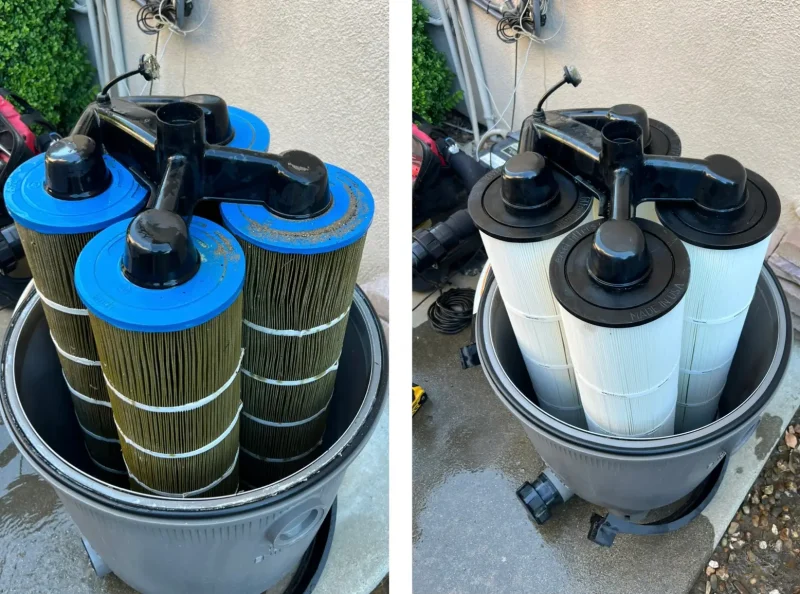
Cartridge filters are the most common filter we see on newer Charlotte pools. They are also the one we install most. They catch particles down to roughly 10 to 25 microns. There is no backwashing, so no water is wasted and no multiport valve to leak. Cleaning means opening the tank and hosing or soaking the cartridges. The secret is size. An oversized cartridge filter, in the 400 to 500 square foot range on a typical pool, goes months between cleanings. It also runs at low pressure with a variable-speed pump. The downside is that cartridges wear out and need replacing every few years.
Sand filters
Sand is the easiest filter to live with and the coarsest of the three. Cleaning is a backwash, done when pressure rises 8 to 10 psi over the clean reading, never on a schedule. The downsides are water sent to waste with each backwash and a multiport valve with a spider gasket that eventually leaks. Sand does not wear out on a timer. It gets changed when it clumps, channels or has an unknown history. We install sand filters with the correct grade of filter sand and inspect the laterals before the tank is closed.
DE filters
DE filters give the finest filtration, down to 2 to 6 microns, and the clearest water. They are also the most work. The grids need backwashing when pressure climbs and a recharge of DE powder after each backwash. They also need a full teardown and cleaning once or twice a year. DE powder is sharp and airborne, and the amount matters. Too little lets oils clog the fabric. Too much bridges the grids. We install DE filters for owners who want the sharpest water and are willing to do, or pay for, the upkeep.
Matching the filter to the pump
Every filter has a maximum design flow rate on its label. The pump must stay under it at every speed it runs. A big pump pushing water through a small filter forces debris through the media, raises pressure and shortens the life of cartridges and grids. On a variable-speed pump this is mostly a programming question. On a single-speed pump it means sizing the filter to the pump. We check the pump model, the pipe size and the plumbing before the filter is chosen.
Replumbing, valves, gauge and startup
A new filter rarely drops onto the old footprint. Tank heights and port positions change between models, so we replumb the inlet and outlet with unions. Sand and DE systems get a new multiport or slide valve when the old one is worn. Every install gets a new pressure gauge. At startup the filter is primed, bled of air and run at each pump speed. The clean starting pressure is written down and left with you. That number is what every future cleaning is judged against.
A filter install often pairs with other work on the pad. A new filter on a tired pump is half a job, so read pool pump installation. Routine cleaning afterward is covered on pool filter cleaning. Owners keeping a sand filter but starting fresh can read about pool sand changes.
Repair, Clean or Replace? When a New Pool Filter Makes Sense
A lot of filter problems are not replacement problems. A torn grid, a cracked lateral, a worn tank O-ring or a leaking spider gasket is a repair. Pressure that stays high after a cleaning is often a bad gauge or a bypassing O-ring. Sometimes the cartridge was never cleaned all the way through. Those are handled on our pool filter repair page.
Replacement makes sense in four cases. The tank is cracked. Pressure stays high after a thorough cleaning on cartridges or grids that are in good shape. That means the filter is too small for the pump and the pool. The filter is undersized for the debris on your lot and you are cleaning it every few weeks in April. Or the parts are obsolete and a simple gasket turns into a hunt. In each case, the money spent nursing the old filter buys very little. A correctly sized new one solves the problem for years.
Signs You Need a New Pool Filter and What to Expect
Water weeping from a hairline crack in the tank, usually near the base or a port. A clamp band that will not seal no matter how it is tightened. Pressure 8 to 10 psi over clean within two weeks of a proper cleaning, in a month that is not April. Cartridges or grids replaced recently that are already loaded. A manufacturer who no longer makes your model’s parts. Any of those is a reason to price a new filter rather than keep repairing the old one.
The install is a single visit in most cases. We confirm the pump model and pipe size and bring the filter named in the quote. Then we pull the old tank, replumb, set the new one and fit the valve and gauge. Then we prime it, run it at each speed and record the clean pressure. The pool stays full. If the pump also needs replacing, we do both in the same visit so the sizing is matched.
Why Charlotte Homeowners Choose Damon's for Pool Filter Installation
Filters get sold by what fits the budget this week, not by what the pool needs. A 200 square foot cartridge under a stand of pines is cheap to buy and expensive to live with. We size to the pump and the debris load, put the model number in writing and explain why that size. If a repair solves the problem for less, we quote the repair instead. Nothing is ordered until you approve the quote.
Damon has serviced Charlotte pools for more than ten years. His Google reviews keep saying the same things: honest about what you need, fair on price, and the water stays clear. We install filters across Charlotte, Matthews, Stallings, Weddington, Wesley Chapel, Waxhaw, Marvin, Fort Mill and Indian Land. Call (980) 998-3777 or request a quote, and have the filter label and pump model handy if you can. Filter installs are one part of our pool equipment installations service.
Our Service Areas
- Charlotte, NC
- Ballantyne
- Matthews
- Stallings
- Weddington
- Wesley Chapel
- Waxhaw
- Marvin
- Fort Mill, SC
- Indian Land, SC
Pool Filter Installation Questions From Charlotte Homeowners
Straight answers to what Charlotte owners ask before replacing a pool filter. Call if yours is not here.
It depends on the filter type and size, whether the plumbing or valve has to change, and whether the pump is replaced too. A large cartridge filter costs more to buy than a small sand filter and less to run and maintain. Damon's Pool Care gives you a written quote with the model number before anything is ordered.
Cartridge filters catch finer particles, waste no water and go longer between cleanings when oversized. Sand filters are the easiest to maintain with a quick backwash but filter coarsest and send water to waste each time. For most Charlotte pools under trees and pollen, an oversized cartridge wins. For an owner who wants the least hands-on work and has a lighter debris load, sand is a fair choice.
A straight replacement is usually a single visit. That includes replumbing to the new footprint, fitting the valve and gauge, priming and recording the clean pressure. If the pump is replaced at the same time, both are done in the same visit. The pool stays full throughout. We walk through the plan in the quote so you know what the day looks like.
Bigger than the minimum. Size to the pump's flow rate first, so the filter's rated flow is never exceeded, then go up for debris load. On a typical Charlotte pool a 400 to 500 square foot cartridge is a working guide, sized on site. Larger filters run at lower pressure, go longer between cleanings and let a variable-speed pump run slower. The only downside is a higher price on the tank.
Tanks last many years if they are not frozen or run over pressure. Cartridges inside them wear out every few years and are a replacement part, not a reason to change filters. Replace the whole filter when the tank is cracked or when pressure stays high after a thorough cleaning on good media. A clearly undersized filter or one with no parts available also qualifies.
DE gives the finest filtration and the clearest water, but it is the most work and the messiest. You backwash, recharge with powder, and tear it down once or twice a year. An oversized cartridge gets water very clear with no backwashing and far less upkeep. Most Charlotte owners who ask us this end up with a large cartridge. Owners who want the sharpest water and do not mind the maintenance pick DE.
For most residential pools in Charlotte, yes, and on a lot under pines and oaks 500 is better. The point of oversizing is lower pressure and fewer cleanings, so there is no penalty to going bigger other than the price. Check the filter's rated flow against your pump's output at its highest speed. We confirm the final size on site from pool volume, pump and debris load.
Yes, and it is a common swap in Charlotte. The multiport valve and backwash line go away, and the inlet and outlet get replumbed to the new tank. The pump stays if it is sized right. You give up backwashing and gain finer filtration and no wasted water. The trade is cleaning cartridges by hand a few times a year instead of turning a valve.
Sometimes. If the new tank takes the same valve mount and the valve is in good shape, it can be moved over. In practice the spider gasket, handle and spring are often worn by the time a tank fails. A new valve on a new tank saves a repair visit a year later. We look at the old valve and quote it either way.
Lower than the old one, often by a lot. There is no single correct number. It depends on the filter size, the pump speed and the plumbing. That is why we record the clean starting pressure at each pump speed on install day. Clean or backwash when the gauge reads 8 to 10 psi above that number. If it is still high right after install, suspect a closed valve or a bad gauge.