
Pool Filter Repair Charlotte, NC
Cartridge, sand and DE filters that leak, lose pressure or send dirt back into the pool, repaired on the pad in Charlotte, Matthews, Waxhaw and Fort Mill.

Pool Filter Repair in Charlotte for Leaks, Valves and Blown Grids
Sand in the pool, water down the waste line, a wet band around the tank. Each one has a specific cause.
A pool filter in Charlotte spends every day under pressure, and the pressure here climbs fast. Pine pollen in April and red clay silt after summer storms load cartridges and DE grids in weeks. Owners backwash more, crank the clamp band tighter and force a stiff multiport handle. Then the small parts give out. The tank O-ring seeps. The spider gasket inside the valve tears and water runs to waste while the pool is on filter. A DE grid splits and powder blows back through the returns. Then a sand filter lateral cracks and sand piles up on the floor. In January a hard freeze can split a tank or valve body left full of water.
Damon’s Pool Care repairs cartridge, sand and DE filters from Hayward, Pentair, Jandy and Zodiac. We cover Charlotte from Myers Park and Dilworth to Ballantyne, Matthews and Weddington. We replace tank O-rings, clamp bands, multiport spider gaskets and handles, DE grids and manifolds, and sand filter laterals and standpipes. Gauges, air relief valves and drain plugs too. Every repair starts with a pressure test and a look inside the tank. The part that failed is the part that gets replaced. A cracked tank is the one thing we will not repair. It is a pressure vessel, and we quote a replacement filter instead of a patch.
Written quote before any work starts. Sand or DE in the pool, water running to waste, a puddle around the tank? Call (980) 998-3777 or request a quote and tell us the filter type and brand.
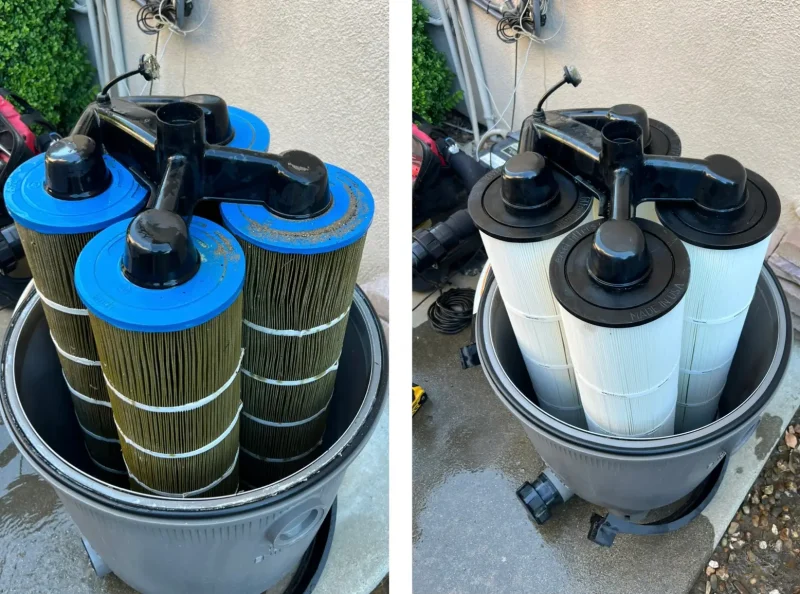




Why Pool Filter Repair Comes Up So Often in Charlotte
Pressure, pollen, freezes and soft water work on every seal in the tank
A filter is a sealed tank with water pushed through it by the pump. Everything that makes it work is a seal or a thin part. Think of the tank O-ring under the clamp band, or the spider gasket inside the multiport valve. Same for the fabric on a DE grid, the slotted plastic laterals under a sand bed, and the end caps on a cartridge. Charlotte is hard on all of them for a few specific reasons.
Pollen and clay push pressure up
Loblolly pine pollen peaks in mid to late April and packs a filter in a couple of weeks. Oak and maple pollen start the job in March. Summer thunderstorms wash Piedmont red clay off decks and lawns into the water as a fine silt. Willow oak leaves from October through December add organic load. Each of those pushes the pressure gauge up. A filter running 8 to 10 psi over its clean number for weeks strains the clamp band, the O-ring and the valve. Owners who backwash constantly to chase the pressure wear out the multiport gasket faster. Owners who ignore it stress the tank.
January freezes and tanks left full
Two or three hard freezes hit Charlotte most winters, usually in January. A filter left full of water during one of them is in trouble. Water expands in the multiport valve body, the drain plug threads and the tank itself. The damage often hides until spring startup, when the valve seeps from a seam or the tank weeps along a hairline crack. We find this most on pads in Waxhaw, Marvin and Fort Mill. Equipment there sits far from the house, and a tripped timer goes unnoticed. The fix for a cracked valve body is a new valve. The fix for a cracked tank is a new filter.
Soft water, added calcium and cemented sand
Charlotte Water comes out of the tap very soft, so we add calcium to nearly every pool here. That calcium, plus pH that drifts high over a summer, forms scale inside filters. On sand filters the top inches of the bed cement into clumps and channels open through them. Unfiltered water bypasses the sand and the pool stays hazy with the chemistry right. On cartridge and DE filters scale stiffens the fabric and raises pressure. Scale is also what makes a multiport handle hard to turn, and a forced handle is how spider gaskets get torn.
Sun and age on the pad
Most filter parts are plastic and rubber. Charlotte summers put them in 90 degree sun for four months a year. Clamp bands get brittle. Pressure gauges fog and stick. Air relief valves crack at the threads. Drain plugs seize. The O-ring in the tank flattens and dries. None of those is an expensive part. Any one of them will leak or let a tank run at the wrong pressure.
Left alone, a small filter problem becomes a big one. A seep at the band becomes a blown O-ring. One torn grid dumps DE into the pool and then into the pump. One cracked lateral sends sand through the returns and onto the plaster. Catching these early is the difference between a repair and a new filter.
Pool Filter Problems We Repair
We work on all three residential filter types: cartridge, sand and DE. Here are the complaints we hear most, what each one usually means, and how we handle it.
Leak at the clamp band or tank seam
Water weeping from the band between the tank halves is almost always the tank O-ring. It flattens, dries out or picks up grit, and no amount of tightening seals it. Tightening further cracks the band. We open the tank, clean the groove, fit a new lubricated O-ring and torque the band correctly. If the leak comes from the tank wall rather than the seam, the tank is cracked. That is a replacement.
Water running to waste on the filter setting
Water out the waste line while the multiport valve is set to filter means a torn or warped spider gasket. The gasket is a star-shaped seal inside the valve, and once it tears water crosses between ports. We open the valve, replace the gasket and check the diverter for scoring. A worn valve body or a cracked diverter is replaced as a unit. A bad valve is often a sign the handle was forced while the pump was running.
DE powder or sand blowing back into the pool
This is damage, not dirt. DE in the pool means a torn grid, a cracked manifold or a missing air relief screen. Sand in the pool means a cracked lateral or a split standpipe under the sand bed. More cleaning or backwashing will not fix either one. On a DE filter we pull the grid assembly and find the breach. The grid or manifold is replaced and the filter recharged with fresh powder. On a sand filter we remove the sand and replace the broken laterals or standpipe. Then it is refilled with the correct grade of filter sand. That job overlaps with our pool sand change service, and we do both in one visit.
Pressure stays high after cleaning
A filter that reads high right after a thorough cleaning has one of four problems. The gauge has failed, which is common and cheap. A valve downstream is partly closed. The cartridge went back in on a worn O-ring and water is bypassing it. Or, on a sand filter, the bed is channeled or cemented. We test the gauge first, then the valves, then open the tank. A gauge that reads zero with the pump running, or never returns to zero when it stops, is replaced.
Handles, gauges, air relief valves and drain plugs
Small parts fail constantly on Charlotte pads. A multiport handle that snaps. A gauge that sticks. An air relief valve that will not seat, or a drain plug that drips. Each one lets air in, water out or the system run blind. We match them to the Hayward, Pentair or Jandy filter on your pad. They get replaced while the tank is open for the main repair.
Cracked tanks
A filter tank operates under pressure, and when it cracks, it is finished. Epoxy, tape and plastic welds all fail. A tank that lets go while the pump runs can injure someone standing at the pad. We do not patch tanks. We quote a replacement filter sized for the pool. The install includes a new gauge, a recorded clean pressure and a check of the valve and plumbing.
Many filter repairs start with something that looked like a cleaning problem. Routine cleanings are covered on our pool filter cleaning page. Pump problems that mimic filter problems, such as weak flow or air in the system, are handled under pool pump repair. One visit covers whichever it turns out to be.
Repair or Replace a Pool Filter?
The decision usually comes down to the tank. If the tank is sound, almost everything else is a part. O-rings, clamp bands, spider gaskets, handles, gauges, grids, manifolds, laterals and standpipes all cost a small fraction of a new filter. Replacing them brings the filter back to full service. We repair filters of any age when the tank holds pressure.
Replacement wins in three cases. The tank is cracked. Pressure runs high after every cleaning because the filter is too small for the pump and the debris load. Or parts are no longer made for the model. An undersized filter on a Charlotte pool under pines and willow oaks is a constant fight. A larger cartridge filter, often 400 to 500 square feet on a typical pool, holds more pollen between cleanings and runs at lower pressure. Our pool filter installation page covers sizing and the cartridge, sand and DE trade-offs. When replacement is the better choice we say so and put both prices on the same quote.
Signs Your Pool Filter Needs Repair, Not Cleaning
Cleaning fixes high pressure from dirt. Repair fixes everything else. Watch for water on the ground around the tank, especially at the band or the valve. Watch for the waste line running while the valve is set to filter, or the pool level dropping on backwash days. DE powder or sand on the pool floor near the returns is a breach inside the tank. Pressure that reads high right after a cleaning, or a gauge that never moves, points to the gauge or a bypass. Air spitting from the returns, a multiport handle that will not turn, or a hissing air relief valve round out the list.
Cloudy water with chlorine and pH in range is the quiet sign. The filter is passing water it should be catching, usually through a channeled sand bed, a torn grid or a bypassing cartridge. Water you cannot see the bottom through is also unsafe to swim in, as the CDC healthy swimming guidance points out. A filter breach is worth fixing before the weekend.
Why Charlotte Homeowners Choose Damon's for Pool Filter Repair
Filter repairs are small parts and careful work. The temptation in this business is to skip the diagnosis and sell a new filter. We open the tank and find the part that failed. A torn spider gasket gets a gasket, not a valve. A worn O-ring gets an O-ring, not a tank. And a cracked tank gets an honest answer and a replacement quote, because patching one is not safe. Every repair comes with a written quote before work starts and the clean starting pressure recorded when we finish.
Damon has serviced Charlotte pools for more than ten years and is licensed and insured. More than a hundred homes in Charlotte, Matthews, Stallings, Weddington, Wesley Chapel, Waxhaw, Marvin, Fort Mill and Indian Land have had him on the pad. His Google reviews keep saying the same three things: honest about what you need, fair on price, and the water stays clear. Filter repair is part of our pool repair services, and most filter trouble shows up first as a pressure reading on a routine visit. Call (980) 998-3777 or request a quote online. Tell us the filter type, the brand and what you are seeing, and we will take it from there.
Our Service Areas
- Charlotte, NC
- Ballantyne
- Matthews
- Stallings
- Weddington
- Wesley Chapel
- Waxhaw
- Marvin
- Fort Mill, SC
- Indian Land, SC
Pool Filter Repair Questions From Charlotte Homeowners
Straight answers to the filter repair questions we get most in Charlotte. If your symptom is not here, call and describe where the water is going.
It depends on the filter type, the brand and which part failed. Gauges, drain plugs, tank O-rings and spider gaskets are small repairs. DE grids, a manifold or a full lateral assembly on a sand filter cost more, because the tank is emptied and the media handled. A cracked tank means a replacement filter. Damon's Pool Care opens the tank, finds the failed part and gives a written quote before any work starts.
Where it leaks tells you why. Water at the band between the tank halves is the tank O-ring. Water from the multiport valve is the spider gasket, the valve cover O-ring or a cracked valve body. A drip at the drain plug or the pressure gauge is the fitting's O-ring or threads. Water from the tank wall itself with no fitting nearby is a crack. All but the last are repairs. A cracked tank is replaced.
No, and it should not be attempted. A filter tank is a pressure vessel. Epoxy, fiberglass patches and plastic welds hold for a while. Then they let go while the pump is running, sometimes violently. Charlotte freezes are a common cause of hairline cracks that show up in spring. If your tank is cracked, shut the pump off and call. We quote a replacement sized for the pool and the pump, not a patch.
The tank on a quality cartridge, sand or DE filter commonly lasts well over a decade in Charlotte. That assumes it is never frozen. The parts inside wear faster. Cartridges and DE grids last several seasons depending on debris load and cleaning, and spider gaskets, O-rings and gauges a few years each. Filter sand does not wear out on a schedule and is changed when it clumps, channels or has an unknown history. Replace the filter when the tank cracks or the model's parts are no longer made.
Something inside the tank has broken. Sand on the pool floor means a cracked lateral or a split standpipe under the sand bed. DE powder at the returns means a torn grid, a cracked manifold or a missing air relief screen. Backwashing or cleaning more will not fix it. The tank has to come apart so the broken part can be found and replaced. On a sand filter that usually means removing the sand, so the job pairs with a sand change.
Usually not. A leak at the joint between the valve and the tank is the valve's base O-ring or the clamp that holds it on. A freeze crack in the valve body does the same. The spider gasket lives inside the valve and causes leaks between ports. Those show up as water running to waste, not out the seam. Pull the valve, inspect the O-ring groove and check the body for cracks. A cracked valve body is replaced whole.
On a sand filter the base is where the drain plug and sometimes the lower union sit. Start there. A drain plug with a dried O-ring or stripped threads is the most common source and an easy fix. If the plug is dry and water comes from the tank itself near the bottom, the tank has cracked. A freeze or years of sun is the usual cause. That is a replacement, not a repair, because the tank runs under pressure.
Three things cause that. The new gasket was not seated in its groove and got pinched when the valve closed. The diverter or valve body is scored or warped, so even a good gasket cannot seal. Or the spring under the handle is weak and does not press the diverter down firmly. Check the gasket seating first. If the body is worn, replacing the whole valve is the fix. Forcing the handle while the pump runs is how most of these start.
A leak that appears only when the pump stops often comes from the filter side. Pressure drops, the tank relaxes, and a worn tank O-ring or a loose clamp band seeps as water settles. The pump's own seals usually leak harder when it is running. Dry the pad, run the pump for ten minutes and look, then shut it off and look again. Note where the first drops appear each time. That tells us which piece to open first.
A little fine dust in the first day or two can happen if the new sand was not rinsed enough. A second backwash and rinse clears it. Real sand on the floor after a sand change is not normal. A lateral was cracked during the refill, a lateral was left unsnapped, or the standpipe was not seated in the valve. The sand has to come out again to check. Pouring sand against the laterals with no water cushion in the tank is the usual way they break.